
Start where you are: Some lessons have to be learned the hard way
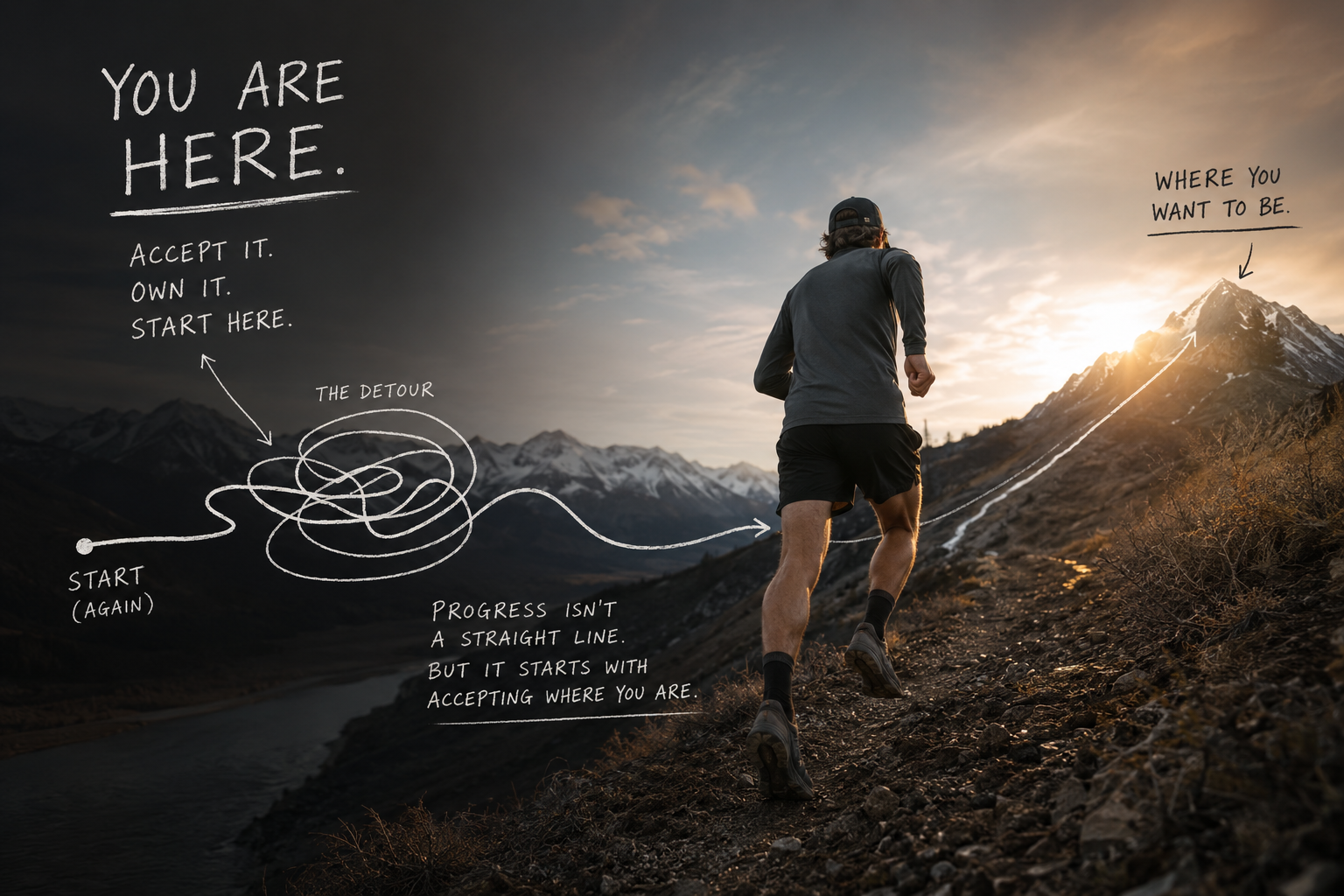
There is no greater challenge athletically than accepting that you are where you are. You may have dreams of where you want to be, goals you’d like to achieve but none of that changes the fact that in order to have a shot at reaching them, you have to figure out where you are today, and start there. Whether you’re trying to win the Tour de France, run your first marathon, or starting from zero on your athletic journey the same principle applies. Over the past several years, through my athletic pursuits, I’ve run into this wall time and time again. Despite knowing better, what I’ve experienced is the perfect illustration of how we are often incapable of being objective when it comes to ourselves. Only recently have I managed to embrace where I am and make some progress.
When I first retired from professional sport at the end of 2019 it’s not a stretch to say that the training I had been putting in since I was a teenager effectively gave me super powers. Swimming and running as a kid, then many years of pro cycling combined with a couple years of professional triathlon, meant that despite extended periods of time spent doing nothing, I could get back on a bike for a few days and be flying, I could go out on a long trail run without preparing for it, or join friends for a masters swim with no concern about whether or not I was fit enough to do so. For several years after I retired from pro sport, the super powers remained, but little by little they began to fade. Finally, in the spring of 2023 I went through something that wiped them out completely. The obstacle came in the form of a nearly complete hamstring tear. While out surfing with a friend in Santa Cruz, in conditions that were nothing but fun and playful, which probably made me more relaxed than I should have been, I made a mistake on a routine takeoff and for the first time in my life both felt and “heard” a pop from my left hamstring. The pain was instantly crippling and I flailed helplessly in the water until my good friend and avid waterman Ricardo grabbed me and helped me to the rocks by Steamer Lane. At this point I discovered I couldn’t bend or move my left leg. A couple of days later, the doctors told me that the pain I was in was due to the fact that the muscle was hanging on quite literally by a thread rather than being a complete tear, and also mentioned it would have been far less painful if I had completely torn it. Due to my age they told me we should give it some time to try and heal naturally and advised that if I could avoid surgery I should. When they told me what the recovery looked like, it was everything I could do not to burst into tears. It’s no secret that sport is a part of who I am, a crucial component of my mental and physical health, and I didn’t know how I would handle the prospect of an extended time period without it.
So, for the second time in three years, I was again reduced to a steady diet of no movement while I healed. As I began my eventual return to activity, a physio who used to work for the Oakland raiders gave me my first wake up call. He told me: “It wasn’t a lack of flexibility that got you, it was a lack of strength. If your hamstring had been stronger you might have withstood the force when your leg pulled away and avoided the tear, or at least avoided the severity”. Stronger? How could that be? I was a former pro cyclist after all. But let’s zoom out for a second. For almost three years before this injury I had done hardly anything that resembled formal training, not to mention I’d severely injured my left ankle just a few months after retiring from Ironman. Sure, I’d ride, run and nordic ski on occasion but never saw the inside of a gym, and never had any consistency. Effectively, by the time I had healed enough from the hamstring injury to slowly start moving again, I was really and truly starting at zero. I had to accept that all the fitness I once had was gone…but I couldn’t do it. Physiologically this made perfect sense, but mentally, I didn’t accept it.
From the time I tore my hamstring up until the winter of 2026 I found myself in what could kindly be termed as a “rinse and repeat” cycle all too familiar to many recreational athletes and even some professionals: add load too quickly, fail to adapt, break down physically, and find yourself back to square one. My mental strength that had once helped me succeed at the highest level of sport was now a detriment. I failed to accept the fact that just because I could do something didn’t mean that I should do it. Whether it was a massive bike ride, a xc ski with a crew far fitter than me, completing the Grand Teton Picnic, or anything in between, I continued to rely on my mental strength rather than putting in the proper physical preparation. Despite being the first one to advise athletes to add load gradually and with caution I somehow held myself exempt from that rule. The problem was, I wasn’t exempt, I just refused to see that. Time and time again I found myself with minor injuries that would lead to more “zero” stretches or falling ill from pushing my body well beyond what it was prepared to do.
Finally, in early 2026, I sat down and took stock of things. I assessed my own fitness as if I was reviewing that of a friend or athlete and the results were disheartening. No aerobic fitness, no strength, really and truly at ground zero. Demoralized would be a kind word for how I felt at the time but I soon realized that I had a choice to make. Fall prey to the story that many middle aged dads tell themselves: I don’t have time, I’m tired, I’m prioritizing my family or work, and so on….or, I could make a change. After a brief bit of self reflection, I couldn’t believe I was actually considering buying into that nonsense, although in hindsight I see how easy it would have been to do.
In February of 2026 I decided to finally accept, and start, where I was, rather than where I wanted to be or, more importantly, where I used to be. The same mental approach that carried me to the front of the Tour de France was going to have to be channeled in another direction: restraint. Starting where I was at that time quite literally meant walking, it meant following the golden rule of accumulating volume before intensity, and prioritizing consistency over heroic efforts. Anyone who knows me knows how much I love a big day out on the feet or on the bike, and it has required incredible restraint to not jump ahead and go after that type of experience.
Restraint was the hard choice, the easy one would have been to give into my urge to just go do the thing I wanted to do. It was humbling to start heading out for consistent walks, and then hikes. It was more humbling to get into the gym and realize that I couldn’t get anywhere near bench pressing my body weight for even a single rep. Slowly but surely, progress was made. Two times a week in the gym along with 3-4 days of aerobic training, week in and week out. In the beginning sometimes aerobic training was as simple as a walk. Gradually, it progressed to a walk/jog or a nice hike on the trails around Truckee. Over time, a 5 mile hike became 10 miles, then 15. Hikes became trail runs and four hours a week of training became eight or nine. A seemingly small number compared to the 20-30 hours I’d regularly log as a pro, but a dramatic jump up from the one or two hours per week I had averaged for the prior years. Throughout it all, when I felt tired, I rested, never hesitating to call an audible and swap a planned run for a hike instead.
In May, after a few months of consistency, I decided I needed a carrot, something to work towards, something to keep me accountable and to look forward to, so I put a couple of trail ultras on the calendar. One in August and one in October. While I knew they’d be long, I also knew they would require a lot of walking or hiking and in many ways could be easier on my body than trying to run a fast marathon. I even consulted my friend and former coach Jesse Moore before I registered for the races, trying to gauge whether I was risking too much from an injury perspective. With my new addition of weight training combined with a willingness to walk when needed and simply complete the distances, Jesse agreed that the injury risk could be mitigated and that I’d likely be fine. Time will tell if this is true, but so far so good!
Since then I’ve continued building and recently, for the first time in as long as I can remember, I’ve been able to have some fun outdoors: a bike ride actually feeling enjoyable again, completing a three hour trail run and feeling good at the end, knocking out a brisk ten miler on the road and feeling no worse for the wear, are just a few examples of the progress that began with time spent walking. Previously, I’d do things like this and feel destroyed, because I hadn’t put in the work, I hadn’t earned the right to do them. I was relying on my genetics and writing checks with my mental strength that my body couldn’t cash and, at thirty seven years old, it seemed like that bill was quickly coming due.
While there is still a long road ahead to regain what I consider to be a level of fitness that allows me to say yes to nearly any adventure with friends, and to continue to future proof my body so that I’ll be doing the things I want to in forty years, the satisfaction I feel at the progress over the past six months rivals that of a good winter of training as I was getting ready for World Tour races like Paris-Nice.
The past several years, and especially the last six months, have also given me a whole new respect for those just beginning their athletic journey or those returning after long periods of illness or injury. Since leaving professional sport, I have helped countless people build their own fitness from the ground up, from never having run a 5k to completing an Ironman, or struggling to ride for 2 hours to completing their first century, but I had never done it for myself. It’s not an exaggeration to say that it was easier to prepare for a top 10 in the Tour de France than to accept where I was several months ago and start there. Despite all of my knowledge and experience, for several years I made the same mistake the majority of people make in their own athletic journeys. Jumping ahead, measuring in weeks, or even months, instead of years. Wanting to see results rather than accepting that change takes time. Putting events on the calendar and rushing the process rather than allowing the body to dictate when the time is right to push.
I’d be remiss not to credit the role that two people who I respect immensely despite not knowing them personally have played in my own athletic journey as I rebuild: Iñaki de la Parra and Alan Couzens. Over the past months, I have drawn repeatedly on the knowledge they share through their writing to remind myself that I was doing the right thing. While I’ve become adept at supporting athletes and executives alike in my professional capacity, I certainly found myself to be the most challenging athlete I’ve ever worked with! At the end of the day, the lessons I learned at the highest level of sport combined with constantly drawing on the simple, foundational wisdom of Couzens and Parra have helped me dramatically change my own trajectory and live in alignment with something I have always believed to be true: sport is about more than performance, it’s a way of life, and for many of us, it’s a core part of who we are. The goal isn’t the next race or event, it’s about being capable of doing the things we love for the entirety of our lives.
Wherever you are on your own athletic journey, we can all benefit from honestly assessing where we are and making the brave choice to begin there. During a time where end results are glorified more than ever, it takes confidence to choose the work, the day in and day out commitment that anything worth doing requires. We can have goals, a north star, but ultimately our success depends on our love of the journey. So start where you are today, take the small steps, and be amazed at where you’ll find yourself in six months, let alone a few years, time.